
Call for Participants: Tensions of Europe Summer School 2026
The Tensions of Europe Early Career Scholars Network is looking forward to seeing you at the summer school organized in connection to the XII Tensions of Europe Conference “The meaning of the past in sustainable futures,” Eindhoven University of Technology, Eindhoven, The Netherlands, 8-10 July, 2026.
The summer school will take place in Dordrecht, the Netherlands, July 6-7, 2026. It aims at introducing early career scholars to the Tensions of Europe community as well as to facilitate networking between scholars across borders, and support the consolidation and building of new academic skills.
The summer school is organised to a large extent around workshops and group discussions. Participants will be asked to do some preparatory readings (3 to 5 papers); to write a short text on their research which will be circulated before the summer school (300-500 words); and to prepare a very brief presentation on it (2-3 minutes). Additional information and materials will be provided after the notification of acceptance.
Confirmed guests include prof. Ruth Oldenziel (TU Eindhoven, Technology and Culture), prof. Nina Wormbs (KTH Royal Institute of Technology), dr. Anna Aberg (Chalmers University of Technology), dr. Emily Clark (University of Amsterdam), dr. Anne Helmond (Utrecht University). The full programme will be published in March.
We invite applicants to submit a short bio and a short text (300-500 words each) on their research project and their motivation for joining the summer school. Participation is open both to PhD and Postdocs.
Applications should be sent by April 15, 2026, 23:59 (CET), through this form:
https://framaforms.org/tensions-of-europe-summer-school-2026-participation-form-1771335576
Applicants will be notified of the results by early May, 2026. If you have questions, you can reach out to Ginevra Sanvitale (sanvitag[at]tcd.ie).
The participants of the summer school are expected to be on-site. Due to the highly interactive nature of most summer school sessions, we are unable to provide online participation.
The participation fee is 50 euro. It includes the welcome dinner, summer school lunches and coffee breaks, and the field trip. Participants will be responsible for their travel plans and accommodation. A limited number of travel grants will be offered to support participants without an institutional budget.
This Tensions of Europe Summer School is sponsored by the ToE network, alongside its institutional partners (Eindhoven University of Technology; Foundation for the History of Technology; European University Viadrina; KTH Royal Institute of Technology; Luxembourg Centre for Contemporary and Digital History (C²DH); National and Kapodistrian University of Athens; Norsk Teknisk Museum), and by the 4TU History of Technology center (Delft University of Technology, Eindhoven University of Technology, the University of Twente, and Wageningen University & Research)
Programme (to be finalised in March):
July 6
Your PhD in 3 minutes – Guests to be announced
In this session, participants presents their PhD or postdoc project and receive feedback from experienced scholars in the history of technology, as well as other Summer School participants.
Sound Recording Technology, Modernity/Coloniality, and the Very Big Sonic Archive – dr. Emily Clark (University of Amsterdam)
With the invention of portable sound recording technology around the turn of the 20th century, early comparative musicologists imagined amassing a vast archive of sonic data recorded in “the field” that could answer big questions about human difference, the origins of creativity, and the nature of humanity. In the present age of digitization and datafication, the imaginary of a very big archive that represents the world’s musical diversity is closer to realization. But the use of historical sound recordings (especially ones from contested contexts) in contemporary knowledge-making practices requires critical reflections on scientific objectivity and sonic evidence of human difference and the past.
In this presentation, I share reflections from my currently ongoing research on ethnographic sound recording collections from the context of Dutch colonial history. Drawing from several collections that were created in the Dutch East Indies, South Africa, the Caribbean, and the rural Dutch countryside, I investigate themes including: the entanglement of methods and theories used in colonial ethnography and European studies of “the folk”; the histories of archival stewardship that make specific sound collections (in)accessible; the digitization and datafication of sound recordings, including for use in contemporary data-driven scholarship; and possibilities for critical reinterpretation of historical collections, for example through restitution or artistic reappropriation.
Digital Methods for Web History: Platform Historiography – dr. Anne Helmond (Utrecht University)
This session introduces digital methods for web history to study websites, platforms, and apps as evolving digital media objects and as key environments where social issues unfold over time. It addresses the challenge that these objects are continuously updated, often overwriting earlier states, while still leaving traces that can be repurposed for historical analysis. The session shows how archived web materials can be used to reconstruct change across multiple levels: (1) Socio-cultural: Using archived pages to track public discourse, controversies, and cultural phenomena unfold over time within archived web spaces. (2) Analysing front-end change, including interface design, platform affordances, and policy texts (for example Terms of Service or moderation guidelines) to examine how participation, visibility, and governance are reconfigured over time. (3) Excavating back-end histories through archived source code to trace the development of tracking and advertising technologies. Participants will learn how to work with web archives to build longitudinal datasets, analyse change across websites and platforms, and develop website or platform biographies. The aim is to provide a practical toolkit for doing historical research with digital traces and web archives, alongside a clear understanding of archival limitations, tool choices, and methodological trade-offs.
July 7
Oral histories in old and new ways. A workshop/discussion about different methods of oral history – dr. Anna Aberg (Chalmers University of Technology)
In this workshop we will discuss the different ways we do or could do oral history (including, but not limited to, through interviews, walks, collective biography writing, witness seminars, group interviews, etc.). You will be asked to present your own experiences with oral history methods, or why you do not use them, and we will touch upon their different challenges and uses.
Reaching beyond the academy – prof. Nina Wormbs (KTH Royal Institute of Technology)
In this session I will share my experience working with non-academic audiences. This can be done in several ways, and on the basis of different kinds of expertise. One is to share research findings with people outside of academia, though popular writing, media participation or public lecture. Another is to put ones skills in reasoning and perspectivising in use in public inquiries, boards or advisory groups. These and other ways of thinking and communicating history of technology does not only profit society, but is also personally very stimulating and feeds back into research and innovation.
Closing lecture – prof. Ruth Oldenziel (TU Eindhoven, Technology and Culture)
Location of Summer School:
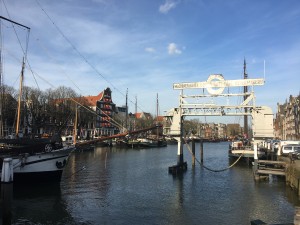 The Tensions of Europe Early Career Scholars Summer School will take place in Dordrecht, the Netherlands, July 6-7, 2026. Dordrecht is a typical water born city in ´Holland´ the western part of the Netherlands. It heydays were in the 13th and the 19th century – making the city a gem for historic architectural styles from medieval times to the present.
The city was the first city to acquire city rights in the county of Holland, and calls itself the ´Oldest city of Holland´ – not the be confused by The Netherlands. The city has it early heydays in the 13th century when city profited from stacking rights on the crossroads of naval trade between Flander and the Hanseatic League. The St. Elizabeth’s flood of 1421 devastated he Dordrecht hinterlands and made the city into a island set in an a inland sea. City´s nobility played important roles in the Dutch revolt from Spain and the establishment of the Dutch East (VOC) and West (WIC) trading companies. Dordrecht was also the site of the Synod of Dort, the European transnational meeting of protestant churches in 1618. Gradual land reclamation and railroad connections introduced a second growth of the city in the nineteenth century. Today the city center of Dordrecht has over a 1000 listed buildings legacies of its 800 years history. During the Tensions of Europe Summer School you will get the opportunities to enjoy this city, its history and its surroundings.
Venue: Stadsklooster Dordrecht https://stadskloosterdordt.nl/en/
The venue of the Tensions of Europe Summer School is the Stadsklooster Dordrecht (City Monastery Dordrecht) The Stadsklooster is located in the former 16th century Leprosy House in the in the heart of the historic town of Dordrecht. It has a nice street terras and in enclosed garden to drink and eat, including a greenhouse if the weather turns out less pleasant).
Meetings of the summer school on Monday 6 and Tuesday 7 July will take place in the Stadsklooster Dordrecht.
Adres: Vriesestraat 117, 3311NP Dordrecht
Places to Stay
Participants of the summer school are free to organize there lodging (the is not included in the fee). These are possibilities in an around the Stadsklooster Dordrecht:
- Stadsklooster Dordrecht. Stadsklooster Dordrecht offers a (limited) number of hotel rooms. Also it offers economic lodging facilities in individual and tow persons Pods, with shared facilities. https://stadskloosterdordt.nl/en/overnachten/
- Stadshotel Steegoversloot is located in the historic center (500 m from Stadsklooster) https://www.stadshotelsteegoversloot.nl/
- Hotel Dordrecht is located at the historic harbor area of Dordrecht (700m from Stadsklooster) https://www.hoteldordrecht.nl/nl/
- Villa Augustus is located in and around the old 19th century Water Tower (900 m from Stadsklooster) https://www.villa-augustus.nl/
- B&B Blom aan de Gracht is at one of the old canals of the historic center (600m from Stadsklooster) and offers two rooms https://www.blomaandegracht.nl/
- Air BnB. Offers many apartments https://www.airbnb.nl/dordrecht-netherlands/stays
Getting to Dordrecht
Dordrecht is well integrated in the Dutch railway system, there is a direct train service from Schiphol airport to Dordrecht
- Arriving by airplane
- From Schiphol airport take the direct train connections to Dordrecht.
- From Eindhoven airport take the airport shuttle to Eindhoven station. There take the intercity service to Breda and/or Rotterdam. Transfer in Breda/Rotterdam to trains to Dordrecht.
- Arriving by train
- From Rotterdam take direct train to Dordrecht
- From Amsterdam take direct train to Dordrecht
- From Utrecht transfer in Rotterdam to direct train to Dordrecht
- From Eindhoven transfer in Breda or Rotterdam to direct train to Dordrecht
Information on the Netherlands Railways train service (generally every 30 minutes) and information on train tickets can be found here: https://www.ns.nl/en
Getting around in Dordrecht
The Stadsklooster venue is at walking distance from the Dordrecht railway station (600 m).
Dordrecht by bike. Dordrecht has a public bike rental system run by Donkey Republic https://www.donkey.bike/cities/dordrecht